DI CANG (ĐỊA THƯƠNG) ACUPOINT AND PEMF TECHNOLOGY: THE MECHANISM OF REGULATING PERIPHERAL CIRCULATION AND RELIEVING THE MUSCLES OF THE MOUTH AREA
Poor flexibility of the expressive muscles, sudden spasms around the corners of the mouth, or accumulated pressure in the lower-face region are often the result of fatigue in the motor nerve fibers. In wellness science, relieving the stiffness of the masticatory muscles and orbicularis oris and opening the biological nodal points is a core factor in maintaining a balanced, natural appearance. The Di Cang acupoint is a strategic coordinate that helps regulate qi and blood and re-establish a state of deep relaxation for the lower-face region.
1. Anatomical analysis and location of the Di Cang acupoint
The Di Cang acupoint (ST4) is an important intersection of the Foot Yangming Stomach meridian with the Hand Yangming Large Intestine meridian, the Yang Heel (Yang Qiao) vessel and the Conception (Ren) vessel, directly governing the expressive muscle groups of the lower face.
-
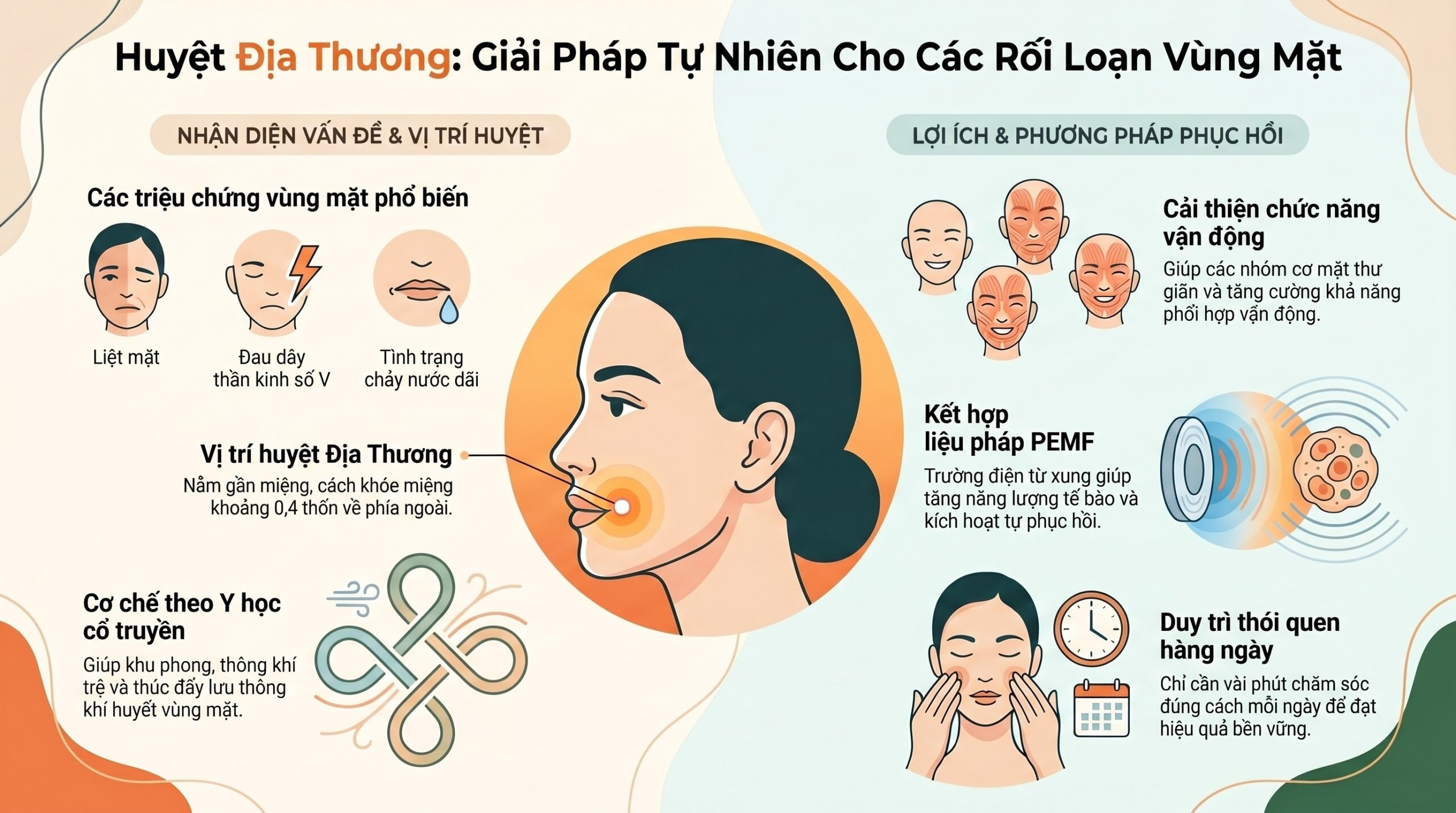
Anatomical location: The acupoint lies in the facial region, right on the horizontal line through the corner of the mouth, about 0.4 cun from the corner of the mouth (or at the intersection of the horizontal line through the corner of the mouth and the nasolabial fold).
-
Structural characteristics: This area concentrates branches of the facial nerve (cranial nerve VII), the sensory branch of the trigeminal nerve (cranial nerve V) and an abundant network of blood vessels nourishing the lips and cheeks.
-
Mechanism of action: According to traditional medicine, Di Cang has the function of dispelling wind, opening qi stagnation and regulating local stomach qi. When stimulated precisely, the acupoint helps relieve the spasm of the orbicularis oris and the depressor anguli oris muscle, allowing qi and blood around the mouth to circulate smoothly.
2. Positive effects on the motor health of the lower-face region
Caring for the Di Cang acupoint brings comprehensive supportive solutions for maintaining the flexibility and balance of the facial muscles:
-
Supporting relaxation of the muscles around the mouth: Quickly soothes muscle stiffness caused by the habit of clenching the jaw or by nervous fatigue, supporting improved flexibility in expressive movement.
-
Supporting the improvement of natural symmetry: Stimulates the flow of qi and blood nourishing the stagnant muscle fibers, supporting the restoration of orbicularis oris muscle tone and preserving the harmony of the overall face.
-
Regulating the peripheral nerve conduction system: Supports good control of secretory disorders of the oral cavity (such as involuntary drooling) caused by the decline in muscle tone of the lower face.
3. Applying PEMF technology in deep-layer functional recovery
Unlike the large muscles of the body, the lower facial muscles have a thin, sensitive structure adhering closely to the surface skin, so crude mechanical pressure by hand easily causes injury or sagging skin. At Arctozen, the Zener specialists apply Pulsed Electromagnetic Field (PEMF) technology as a deep, micro-level intervention solution:
-
Refined penetration of soft tissue: Low-frequency PEMF waves possess a gentle penetrating ability, going deep through the layers of the epidermis to interact directly with the orbicularis oris muscle fibers and the facial nerve roots without the need to press strongly on the skin surface.
-
Recharging cellular energy: The electromagnetic pulses are compatible with the body's biological frequencies, stimulating the mitochondria to increase natural biological energy production and supplying fuel for the tired muscle cells around the corners of the mouth to accelerate their natural recovery.
-
Enhancing local microcirculation: PEMF promotes the flow of oxygen-rich blood to the tiny capillaries around the mouth and cheeks, enhancing nutrient metabolism, releasing the points of energy blockage and bringing lightness to the nervous system.
4. The professional care protocol by Zener
Each protocol for restoring the function of the lower-face region at Arctozen is strictly designed according to scientific standards by the Zener team:
-
Anthropometric survey: The Zener precisely locates the 0.4 cun distance from the corner of the mouth based on the distinct bone and facial muscle structure of each client.
-
Activating the bioelectric current: Using a gentle, penetrating acupressure technique, applying a refined touch to release the spasm of the superficial muscle bundles around the mouth and reach a stable state of deqi.
-
PEMF magnetic-field resonance: The PEMF technology is set to a suitable frequency band, transmitting energy pulses directly into the Di Cang acupoint area to support opening the pathways and bring a balanced state to the head and face.
5. Indications and safety notes
-
Indications: People with tense, tired facial muscles, people working in high-pressure environments that cause jaw muscle spasms, or those who wish to maintain the flexibility and balance of the expressive muscle groups around the mouth.
-
Contraindications: To ensure the utmost safety, PEMF therapy is not applied to pregnant women, people with open skin lesions or acute inflammation of the lips and cheeks, and clients using implanted electronic support devices such as pacemakers or defibrillators.
This knowledge is shared for the purpose of supporting proactive health care and improving quality of life. Please consult a specialist before undergoing in-depth therapies.